Key points
- On 28 February, Israel conducted a pre-emptive strike on Iran; the US President Donald Trump then announced US military operations in Iran, indicating a combined campaign framework.
- Iran’s Supreme Leader Ali Khamenei was killed in Israeli‑US strikes during “Operation Roaring Lion/Epic Fury”.
- Strikes in Iran reportedly included leadership/command targets in Tehran and force-degradation targets (Tabriz Airport aircraft; an Iranian naval vessel in Chabahar).
- Iran’s retaliation was region-wide and multi-modal (ballistic/cruise missiles and mass drones), affecting Israel and multiple Gulf states’ airports/bases, driving severe aviation disruption.
Analysis
On February 28, 2026, the United States and Israel launched a large-scale joint military campaign against Iran, designated “Operation Epic Fury” by the U.S. Department of War and “Operation Roaring Lion” by Israel. The operation was framed as a preemptive strike, publicly justified by Iran’s nuclear program, ongoing ballistic missile development, and stalled diplomatic negotiations. The campaign extended into the early hours of March 1, 2026, with multiple successive waves of airstrikes targeting sites across at least 24 of Iran’s 31 provinces.
This report analyses events that occurred between February 28 and March 1 2026.
Timeline of key events
- 28 Feb (early): Israel reported launching a pre-emptive attack on Iran; explosions were reported in parts of Tehran.
- 28 Feb: Iran’s Supreme Leader Ali Khamenei was killed in Israeli‑US strikes during “Operation Roaring Lion.”
- 28 Feb: Israel declared a state of emergency and imposed nationwide restrictions (education, gatherings, most work), consistent with anticipating retaliatory salvos.
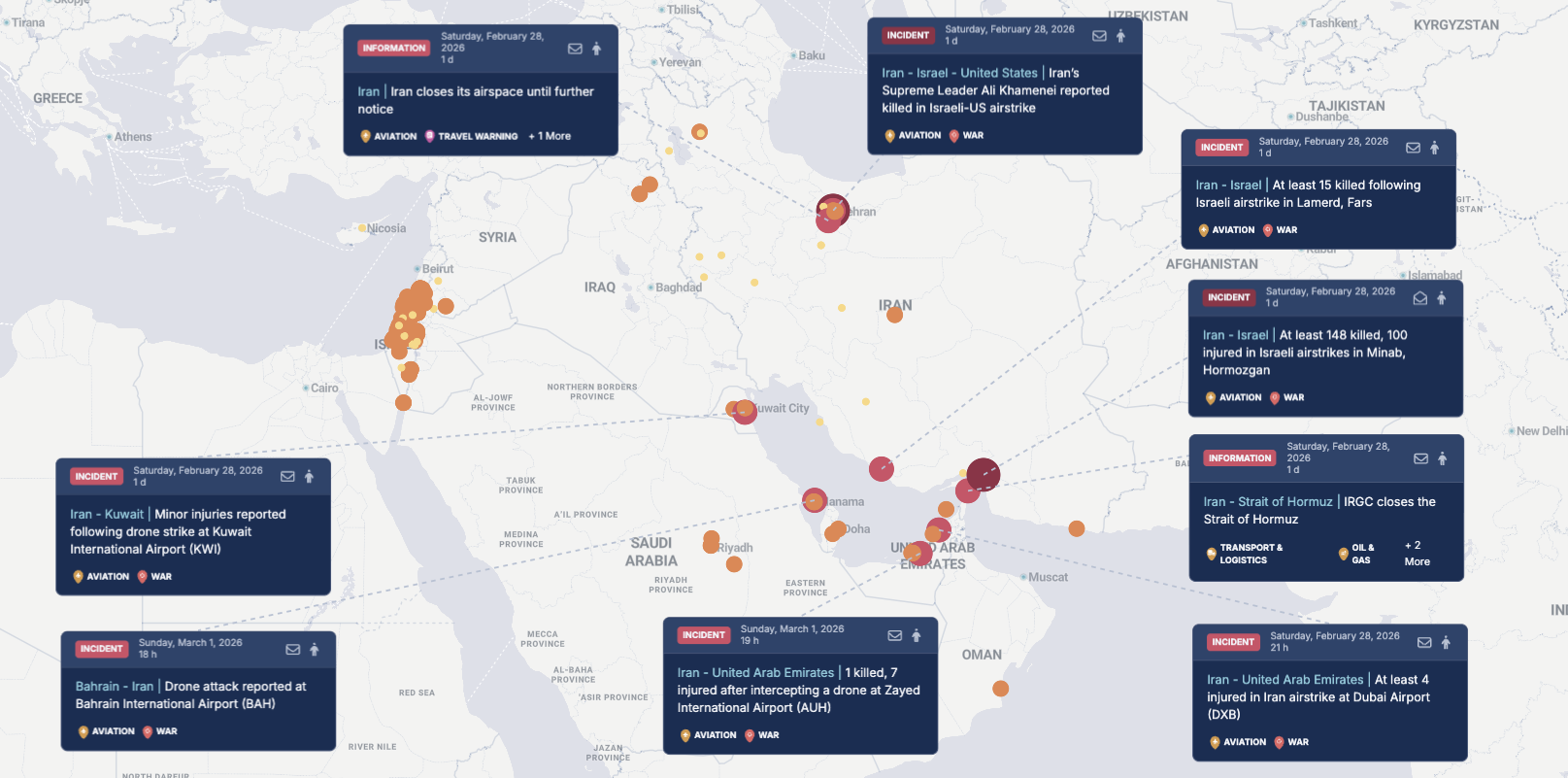
- 28 Feb: Israel closed its airspace for civilian flights until further notice.
- 28 Feb: Iran closed its airspace until further notice.
- 28 Feb: The US President announced the launch of US military operations in Iran.
- 28 Feb: The US Embassy issued a “shelter-in-place” order to US citizens in Iran due to ongoing military operations.
- 28 Feb: Iran began retaliatory strikes across the region, including reported attacks/interceptions near Qatar (including later reporting of missiles on Al-Udeid), Kuwait, Saudi Arabia, the UAE, and Bahrain (including a reported strike on a US base).
- 28 Feb: Kuwait reported at least three soldiers injured after missile/drone strikes at Ali Al‑Salem Air Base.
- 28 Feb: Iran’s National Security Council reportedly advised residents to leave Tehran.
- 28 Feb: IRGC was reported to have closed the Strait of Hormuz and warned ships not to transit.
- 1 Mar: US CENTCOM announced it struck an Iranian Jamaran-class corvette in Chabahar, stating it was sinking at a pier.
- 1 Mar: US CENTCOM reported three US personnel killed and at least five injured during “Operation Epic Fury.”
- 1 Mar: Israel claimed it destroyed Iranian F‑4/F‑5 aircraft at Tabriz Airport.
- 1 Mar: In Iraq, police used live fire and tear gas to disperse protesters attempting to approach the US Embassy in Baghdad, with reporting linking protests to Khamenei’s death.
Targets
Strategic Leadership and Command Infrastructure
The highest-profile target of the operation was Supreme Leader Ayatollah Ali Khamenei and Iran’s senior security establishment. U.S. and Israeli officials confirmed strikes on Khamenei’s compound in central Tehran, near the offices of the Supreme Leader on University Street and Jomhouri Avenue. The death of the Supreme Leader was later confirmed by Iranian authorities.
The IDF officially announced the elimination of at least seven other senior Iranian Defence Leadership officials, including:
- Ali Shamkhani — Senior Security Adviser
- Mohammad Pakpour — IRGC Ground Forces Commander
- Saleh Asadi, Mohammad Shirazi, Aziz Nasirzadeh, Hossein Jabal Amelian, Reza Mozaffari-Nia
- Four senior intelligence commanders (foreign intel, security, counterterrorism, and advisory units)
Ballistic Missile and Air Defence Systems
The stated primary military objective was the systematic destruction of Iran’s ballistic missile infrastructure and air defence networks. Multiple waves of strikes specifically targeted missile launch sites, missile storage facilities (including Kder-H-1 systems carrying hundreds of kilos of explosives), and radar and air defence installations across western and central Iran. The IDF stated these strikes thwarted dozens of active launch attempts directed at Israeli territory.
Nuclear Infrastructure
Isfahan — a known hub for Iran’s nuclear and missile programs — was struck in multiple waves. Reporting referenced attacks on nuclear-related industrial sites, with Israel urging residents in an Isfahan industrial zone to evacuate immediately prior to strikes. U.S. media identified a nuclear centre in Isfahan as among the confirmed targets.
Military Concentrations and Urban Infrastructure
Beyond leadership and strategic systems, strikes hit military troop concentrations in Tabriz and Sanandaj, the presidential complex in Tehran, and Mehrabad International Airport. Reports confirmed explosions across at least ten cities, including Tehran, Isfahan, Qom, Khorramabad, Kermanshah, Karaj, Tabriz, Bandar Abbas (struck by Jenin Joint Operations), and Lorestan.
Civilian Sites
The most internationally condemned aspect of the operation was the destruction of civilian educational facilities. Strikes hit a girls’ elementary school (Shajareh Tayyebeh Primary School) in Minab, southern Iran, a high school in Tehran, and reportedly two additional schools elsewhere — a total of at least three educational institutions. Iranian authorities, the Red Crescent, and Iran’s UN Ambassador Amir Saeid Iravani characterised these strikes as deliberate war crimes. The U.S. and Israel did not formally acknowledge these sites as intended targets.
Modality of Operations
Scale and Force Composition
The IDF described the operation as the largest in the history of the Israeli Air Force. Approximately 200 fighter jets were deployed, striking approximately 500 targets across Iran in multiple successive waves. U.S. forces contributed carrier-based aircraft from the USS Abraham Lincoln, combat aircraft from regional Middle East bases, and THAAD missile defence assets.
Wave Structure
The assault was conducted in at least three distinct waves, escalating in geographic scope. Wave 1 targeted Tehran, Qom, Isfahan, and Khorramabad. Wave 2 expanded to additional central Iranian sites, particularly missile launch infrastructure. Wave 3 and subsequent waves involved continued strikes in western and central Iran, with fresh IAF announcements at each stage. Simultaneous strikes were also reported in southern Lebanon.
Cyber and Information Operations
Concurrent with the kinetic campaign, the Iranian state media infrastructure was subjected to cyberattacks. Iran’s official news agency IRNA was hacked and rendered inaccessible, as were ISNA, Rokna, and Tabnak. Hacked messaging proclaimed that the IRGC and Basij had received ‘a paralysing blow.’ This information dimension of the operation contributed to significant uncertainty about the status of Iranian leadership and casualties.
Iranian Counterstrike
Iran’s Islamic Revolutionary Guard Corps announced retaliatory action, launching missiles toward U.S. Persian Gulf allies and reportedly targeting U.S. bases including Al Udeid in Qatar and Al Dhafra in the UAE. UAE airspace was temporarily closed, and a missile was intercepted near Al Udeid. Iranian drones also reportedly struck a third country’s civilian airport hub. Iran’s ability to project further force, however, was assessed by analysts as significantly degraded.
Outcomes
Casualty Figures
As of March 1, 2026, the Iranian Red Crescent reported at least 201 dead and 747 wounded across 24 provinces, with the organisation on full national alert. Key sub-figures within the overall toll include:
| Incident | Location | Reported Killed | Source |
| Girls’ school strike | Minab | 100–115 | Red Crescent / Al Jazeera |
| High school strike | Tehran | Dozens (est.) | Iranian health officials |
| Additional school strikes (x2) | Multiple | 86 students total | Iranian Ministry of Education |
| Sports facility (gymnasium) | Unnamed city | ~20 | Multiple reports |
| Overall Red Crescent total | 24 provinces | 201+ dead, 747 wounded | ISNA / Red Crescent |
Military and Leadership Outcomes
The IDF confirmed the elimination of at least seven senior Iranian officials, including Supreme Leader Khamenei, and four senior intelligence commanders.
The ballistic missile system suffered significant degradation: the IDF stated that dozens of launches were thwarted as a direct result of strikes on missile infrastructure. Air defence systems across the country were systematically targeted and partially or fully disabled.
Strategic and Political Outcomes
Iran’s nuclear program sustained direct strikes in Isfahan, though the operational extent of damage to nuclear facilities remained unclear at time of writing. Iran declared airspace closure and a national state of emergency. The FBI raised the U.S. domestic terrorist threat level in response to the operation. Iran’s UN representative filed formal accusations of war crimes at the Security Council.
Within Iran, the operations triggered two distinct popular responses: widespread civilian distress and grief, particularly over school strikes; and celebrations in multiple cities (Isfahan, Karaj, Mashhad, Abdanan, Saqqez) amid reports of Khamenei’s death — accompanied by clashes between IRGC/Basij forces and protesters.
Regional Escalation Indicators
The conflict showed early signs of broader regional escalation. Missile interceptions near U.S. Gulf bases, airspace closures in Iran and Iraq, India issuing travel advisories, and Iran striking U.S. regional allies all pointed to a conflict rapidly moving beyond a bilateral exchange. Expert commentary noted that while Iran’s capacity for sustained external terror operations was assessed as greatly diminished, the country retained residual capability to target Gulf states and U.S. installations.
Travel disruption: airspace closures, airport risk, cancellations, and routing impacts
Aviation disruption was structurally driven by state airspace closures: Israel closed its airspace for civilian flights and Iran closed its airspace until further notice, which typically forces immediate cancellations, diversions, and longer routings around the Levant and Iranian FIR.
Operational risk then extended to airports as targets or collateral-damage sites—DXB, AUH, and BAH all had reported strike/debris incidents—raising the likelihood of temporary ground stops, delayed recovery waves, and airline network knock-on effects even where airspace remains nominally open.
Maritime disruption (Strait of Hormuz and adjacent waters)
Maritime risk increased in parallel with aviation disruption. Reporting claimed the IRGC “closed the Strait of Hormuz,” while UKMTO issued incident reporting/warnings near Ras Al Khaimah and north of Oman, and Oman reported an oil tanker targeted off Musandam with injuries.
Forecast (next 48-72 hours)
Continued Kinetic Operations
Israel and the U.S. are likely to conduct follow-on precision strikes in the next 48–72 hours targeting residual ballistic missile launch infrastructure, reconstituted air defence nodes, and any confirmed surviving senior regime figures. The pattern of successive waves observed on February 28–March 1 suggests a doctrine of persistent attrition rather than a one-time decapitation strike. Iran will attempt to launch residual missile and drone salvos against Israeli territory and U.S. Gulf installations; however, degraded command infrastructure and destroyed launch sites substantially limit this capability. Hezbollah activation from southern Lebanon remains a credible wildcard, though its own degraded stockpiles constrain its offensive potential.
Forecast: 2–4 additional Israeli strike waves against Iran within 7 days (high confidence). Limited Iranian retaliatory launches against Gulf bases (medium confidence). Hezbollah limited engagement from Lebanon (low-to-medium confidence).
Diplomatic and International Response
An emergency UN Security Council session is expected within 24–48 hours. Russia and China will likely introduce a ceasefire resolution; the U.S. will veto. European governments face significant domestic pressure to condemn civilian casualties while avoiding direct confrontation with Washington. Oil markets will experience acute volatility, with Brent crude expected to spike 15–25% on Strait of Hormuz closure fears within the first 72 hours. Iran may attempt to leverage its position in the Strait as a bargaining chip without fully closing it. Gulf Cooperation Council states will pursue quiet diplomatic back-channels to prevent further escalation threatening their own infrastructure.
Forecast: No binding ceasefire within 7 days (high confidence). Significant oil price shock within 48 hours (high confidence). Partial Hormuz disruption via Iranian threats or limited mining (medium confidence). ICJ emergency measures filing by Iran (high confidence by the end of the week).
Internal Stability in Iran
Reports of popular celebrations in Isfahan, Karaj, Mashhad, and other cities — alongside IRGC crackdowns on protesters — indicate a deeply divided public response. Two competing dynamics are in play: a rally-around-the-flag effect driven by civilian casualties and nationalist sentiment, and an opposition current emboldened by signs of regime decapitation. The IRGC and Basij will likely escalate domestic repression significantly in the first 72 hours to prevent organised protest. However, if Khamenei’s death is confirmed, the regime’s legitimacy apparatus faces an existential test that it may be unable to contain through force alone.
Forecast: Significant protest activity across multiple Iranian cities within 3–5 days (high confidence). Intensified IRGC crackdown, including internet shutdowns and mass arrests (high confidence). Risk of localised breakdowns in IRGC command coherence, particularly in provinces bordering ethnic minority regions (medium confidence).